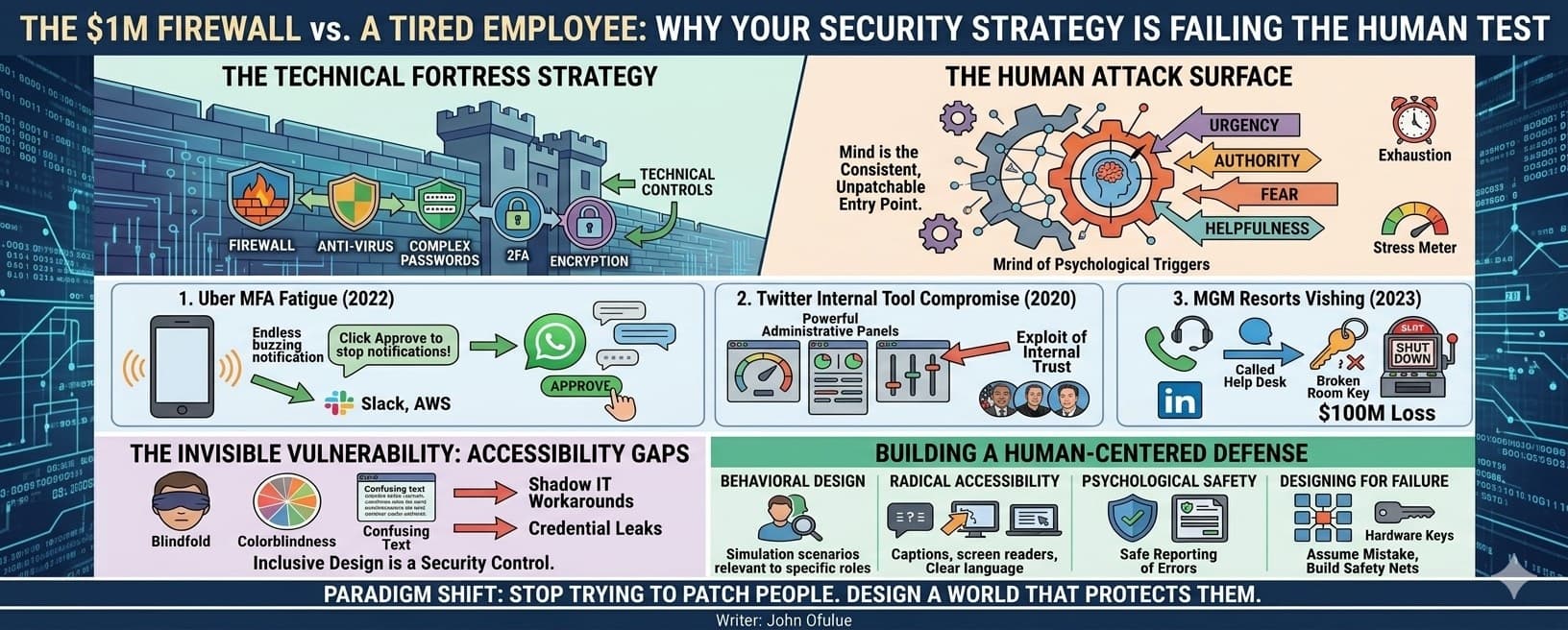
Most organizations operate under a dangerous delusion. They believe that if they buy enough "blinky boxes", install enough agents, and enforce enough complex passwords, they are safe. They view security as a technical fortress. However, history has proven that while you are busy fortifying the front gate, attackers are simply calling your employees and asking for the keys.
This is the reality of the Human Attack Surface. In a world where technical vulnerabilities are patched within hours, the human mind remains the most consistent, unpatchable, and exploited entry point in the modern enterprise. If your strategy ignores the person behind the keyboard, you are not building a fortress; you are building a paper wall with a very expensive lock.
The Psychology of the Modern Breach
Attackers have pivoted from breaking code to breaking people. They understand that it is significantly cheaper and faster to exploit a tired, stressed, or helpful employee than it is to find a zero-day vulnerability in a hardened firewall. This approach focuses on what many call the Human API, leveraging psychological triggers like urgency, authority, and fear to bypass billions of dollars in technical controls.
Security is not a technical problem with a human component. It is a human problem that manifests through technical systems. When we fail to account for how people actually work, think, and interact with technology, we create gaps that no amount of software can fill.
Case Study: The Uber MFA Fatigue Attack (2022)
The 2022 breach of Uber serves as a masterclass in exploiting human biology. The attacker did not use a sophisticated malware strain. According to official reports from Uber, the breach originated from a contractor whose account was compromised via social engineering tactic. They used a technique known as MFA Fatigue. After obtaining an employee's credentials through a simple phishing link, the attacker triggered a relentless stream of Multi-Factor Authentication (MFA) push notifications to the employee’s phone.
For over an hour, the employee’s phone buzzed. Finally, the attacker contacted the employee on WhatsApp, pretending to be from Uber IT. They told the employee that the notifications would only stop if they clicked "Approve." Exhausted and frustrated, the employee complied. That single click granted the attacker access to Uber’s internal Slack, AWS, and Google Workspace environments. The failure here was not the MFA itself, but the failure to design a system that accounted for human fatigue and the desire to stop a nuisance.
Case Study: The Twitter Internal Tool Compromise (2020)
In 2020, some of the world’s most powerful Twitter accounts, including those of Barack Obama and Elon Musk, began tweeting cryptocurrency scams. The world assumed a massive technical exploit was at play. The reality was far more mundane.
Attackers used a coordinated social engineering campaign to target a small number of Twitter employees. By masquerading as colleagues or IT support, they gained access to internal administrative tools that allowed them to take over any account on the platform. This was a direct exploit of internal trust. It highlighted a critical lesson: if your internal tools are powerful but your people are not trained to recognize manipulation, your entire platform is at risk.
Case Study: The MGM Resorts Vishing Campaign (2023)
One of the most disruptive attacks in recent years hit MGM Resorts. The group behind it, Scattered Spider, did not use a single line of malicious code to get in. They found an employee’s name on LinkedIn, called the MGM help desk, and used "vishing" (voice phishing) to convince the support agent to reset a password and MFA device.
Within ten minutes, the attackers had a foothold. The resulting shutdown of hotel systems, digital room keys, and slot machines cost the company roughly $100 million. This breach proves that the help desk is often the weakest link in the security chain because it is designed for efficiency and helpfulness, which are the exact traits attackers exploit.
The Invisible Vulnerability: Accessibility in Security
There is a massive gap in the conversation regarding human factors: Accessibility. For years, security training and tools have been designed for a "standard" user, often ignoring those with visual, auditory, or cognitive disabilities. This is not just a diversity and inclusion issue; it is a profound security risk.
If a security alert is not screen-reader compatible, a blind employee may ignore it. If a phishing simulation relies on color-coded cues that a colorblind employee cannot see, they are more likely to fail. If security policies are written in dense, academic jargon that is inaccessible to neurodivergent employees, those policies will be ignored or misunderstood.
When security is not accessible, it becomes a burden. Humans naturally seek the path of least resistance. If a security control is too difficult to navigate because of poor design or lack of accessibility features, employees will find "workarounds" to get their jobs done.
Why Inaccessible Design is a Security Risk
These workarounds are the birthplace of shadow IT and credential leaks. An employee who cannot easily use the corporate VPN because of a UI that does not support keyboard navigation might start using a less secure, personal alternative. Inclusive design is a security control. By making security easy and accessible for everyone, you reduce the friction that leads to human error.
Accessibility improves comprehension, retention, and usability. If an employee cannot properly access training, they may miss phishing indicators or misunderstand critical policies. That gap becomes a vulnerability that an attacker will eventually find.
Building a Human-Centered Defense
To move beyond the "weakest link" mentality, organizations must shift toward Human-Centered Security. This involves designing systems that assume humans will make mistakes and building safety nets to catch them.
- Behavioral Design: Move away from annual "tick-the-box" training. Use real-world simulations that are relevant to specific roles.
- Radical Accessibility: Ensure every piece of security content, from training videos to incident report forms, meets global accessibility standards. Captions, screen-reader support, and clear language are mandatory.
- Psychological Safety: Create a culture where employees feel safe reporting a mistake. If an employee is afraid of being fired for clicking a link, they will hide the error, giving the attacker more time to dwell in the system.
- Designing for Failure: Implement technical controls that assume a human will click the link. This includes robust micro-segmentation and "phishing-resistant" hardware keys that do not rely on human judgment.
Securing the Decision, Not Just the Device
Cybersecurity is the sum of billions of individual decisions made by people every single day. We spend millions securing the devices, but we often spend pennies securing the decisions.
The organizations that will survive the next decade of cyber threats are not those with the biggest budgets, but those that understand human behavior. By combining psychological awareness with radical accessibility, we can turn our people from our greatest vulnerability into our most formidable line of defense. The goal is simple: stop trying to patch the people and start designing a world that protects them.