The Invisible Key: Why Curiosity is Your Most Dangerous Weapon
Imagine you are standing in front of a house. This isn't just any house. It has thick concrete walls. It has a high-tech camera on every corner. It has a massive iron gate with a keypad that requires a twenty-digit code. From the outside, it looks like a fortress. You would think that nobody could ever get inside without an invitation.
But then you walk around to the back. There, you find a small bathroom window. It is made of thin glass, and more importantly, it is slightly cracked open because the latch is broken. In the world of cybersecurity, we spend billions of dollars on the concrete walls and the iron gates. We buy the most expensive software and the loudest alarms.
Most of the time, the "bad guys" don't try to climb the gate or smash the concrete. They just look for that one missing brick or that one unlatched window. According to the Verizon Data Breach Investigations Report, the majority of successful attacks still rely on these simple human errors rather than complex technical exploits.
If you are a beginner in this field, the most important thing you can learn is this: Security is not a product you buy. It is a habit you build. This philosophy is at the heart of Defense in Depth, a strategy that assumes one layer will eventually fail and focuses on creating multiple levels of protection.
The Myth of the "Magic Tool"
When people start learning about cybersecurity, they usually ask the same question: "What is the best tool I should learn?" They want to know the name of the software that will make them a pro. They think that if they just learn how to use a specific scanner or a certain piece of code, they will be secure. This is like a chef asking what the best frying pan is. A great pan helps, but it won't make the food taste better if you don't know how to cook.
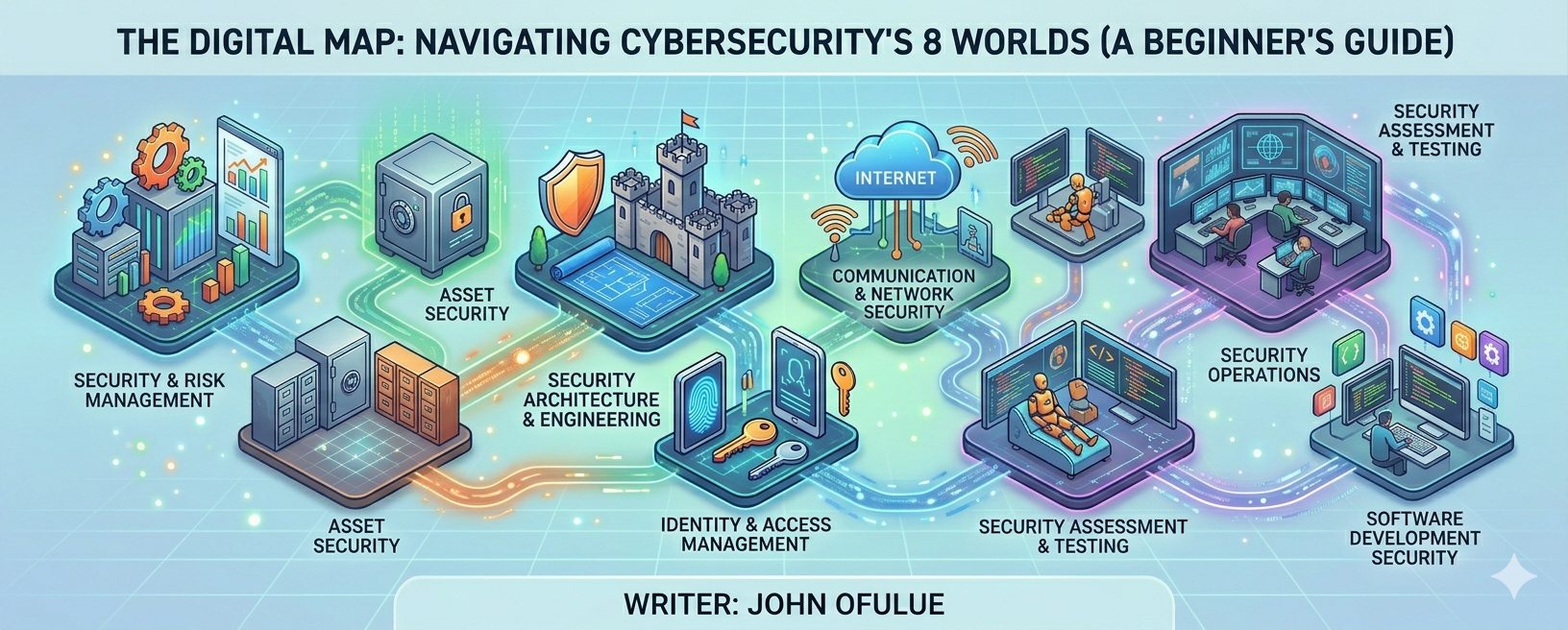
In cybersecurity, tools change every single year. The software you use today might be gone tomorrow. What doesn't change is the logic behind how things break. Beginners often focus on the "how" (how do I run this tool?) when they should be focusing on the "why" (why does this specific flaw exist in the first place?). To help you understand that "why," experts use a map called the CISSP domains.
These are eight specific areas that cover everything you need to know to keep a digital environment safe. Understanding these eight worlds will help you find where you fit in so you focus on the tools particular to your desired domain.
1. The Strategy Room: Security and Risk Management
This is the brain of the operation. Before you buy any tools or write any code, you need a plan. This domain is all about the big picture. Imagine you are protecting a bank. You have to decide what is most important to guard. Is it the cash in the vault? The customer names? The employees? You can't spend a million dollars protecting a ten-dollar chair.
This is called Risk Management. It is the art of figuring out what could go wrong and deciding how much time and money to spend on stopping it. People in this domain write the rulebook that everyone else in the company has to follow. It is less about typing code and more about understanding business, laws, and ethics.
2. The Inventory Vault: Asset Security
You cannot protect what you don't know you have. This domain is all about keeping track of your digital property. In the digital world, "stuff" means data. This includes credit card numbers, home addresses, or even a company's secret recipe. Asset security is about labeling this data. Is it "Top Secret" or is it "Public"?
Once you know what the data is, you have to decide how to destroy it when you don't need it anymore. You can't just throw a hard drive in the trash. You have to make sure the data is gone forever. It is like being a librarian for a secret library. You are responsible for the Data Lifecycle, from the moment it is created until it is safely deleted.
3. The Master Blueprint: Security Architecture and Engineering
This is where the builders live. If you want a house to be safe, you don't just put a lock on the door. You build it with strong materials and a smart design. This domain focuses on how systems are built from the ground up. It covers everything from physical locks to the way a computer processes information.
It also includes "secret codes" known as encryption. When you see that a message is encrypted, that is the work of security engineering. If you understand how a computer talks to another computer, you don't need a fancy tool to tell you when a conversation looks suspicious. You will be able to see it for yourself because you understand the architecture.
4. The Busy Highway: Communication and Network Security
Computers are almost never alone. They are always talking to each other over the internet or through office cables. This domain is about protecting the roads that data travels on. Think of the internet like a highway. If you are sending a truck full of money down that highway, you want to make sure nobody can hijack the truck.
This area deals with things like WiFi, firewalls, and secure connections. The goal here is to make sure that when data moves from Point A to Point B, it stays private and doesn't get changed by someone in the middle. This is often referred to as protecting Network Infrastructure.
5. The Digital Bouncer: Identity and Access Management (IAM)
This is about one question: "Who are you, and what are you allowed to do?" Imagine a large hotel where every guest has a key card. A guest's card might open their room and the gym, but it shouldn't open the manager's office. In cybersecurity, this is IAM. It covers passwords, fingerprint scans, and those text message codes you receive when logging in.
However, there is a hard truth here. If security is annoying, people will find a way to bypass it. If a guest has to scan their thumb five times just to enter the gym, they will eventually prop the door open with a weight. As a beginner, you must learn empathy. You have to design security that works for humans. If you make the "right" way too hard, people will always find a "wrong" way that is easier.
6. The Fire Drill: Security Assessment and Testing
How do you know if your security actually works? You test it. This domain is about finding the holes before the bad guys do. It involves drills where you pretend to be a hacker to see if you can get in. This is often called Penetration Testing.
It is like a car company doing crash tests. They don't just hope the car is safe. They smash it into a wall to find out exactly where it breaks. This is where you learn that hacking is mostly just patience. Movies make hacking look like a fast-paced race with glowing text. In reality, it is more like fishing. An attacker might spend weeks just watching. They scan ten thousand windows and wait to find the one that is unlatched. You are the one who checks the latch on every window every night.
7. The Night Watch: Security Operations
This is the day-to-day work of keeping things safe. It is the front lines. Think of a large company's network like a busy neighborhood. Every day, thousands of cars (data packets) drive in and out. Security Operations is like the neighborhood watch room. You are sitting in front of monitors, watching the traffic.
Your job isn't to stop every car. That would ruin the neighborhood. Your job is to look for the car that is driving too slowly, the one that has its lights off, or the one that is circling the same house over and over again. Hacking is rarely a loud explosion. It is usually a series of quiet, weird events. Being a great security professional means being a great observer. You have to know what "normal" looks like so you can spot the "weird" stuff before it becomes a disaster.
8. The Secure Factory: Software Development Security
Almost everything we do today happens inside an app. If the person who wrote the app was lazy, they might have left a backdoor open. This domain is about teaching programmers how to write clean code. It is easier to build a secure app from the start than it is to try and fix a broken one later.
This concept is known as Shift Left Security. It is like food safety. You want to make sure the food is clean before it ever leaves the factory. By integrating security early, you prevent expensive and dangerous mistakes before they ever reach the public.
Your First Step into the Fog
If you are feeling overwhelmed by all these terms, take a breath. Nobody knows everything. The field is too big for that. Start by being curious about how things work when they are not broken. How does a website show up on your screen? How does your phone know your password is correct? Once you understand the normal way things work, the broken way will start to stand out like a sore thumb.
Cybersecurity is a journey of constant learning. It is a puzzle that never ends because the pieces are always moving. But if you keep your focus on the people you are protecting and the simple habits that keep them safe, you will be ahead of ninety percent of the people in the room.
The Bottom Line
Don't worry about being the smartest person in the room. Worry about being the most observant. The biggest threats aren't usually high-tech digital ghosts. They are just open windows and missing bricks. Your job is to find them before someone else does.