In 2026, artificial intelligence is no longer just a tool businesses use to work smarter. Cybercriminals are using it too. And they're using it to attack faster, smarter, and quieter than ever before.
Here's what's happening right now — and what you need to do about it.
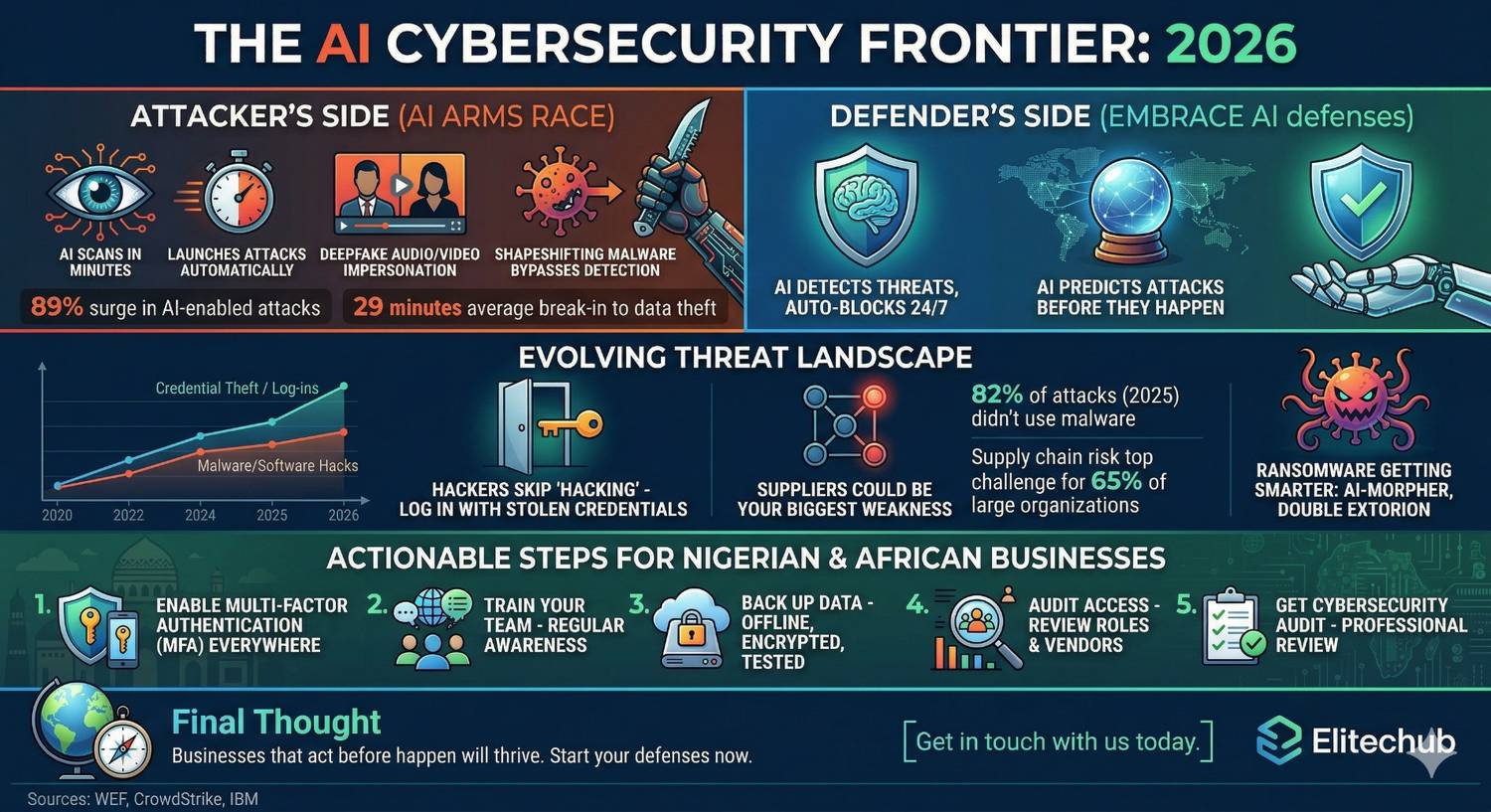
The AI Arms Race: Hackers vs. Defenders
Think of AI like a very powerful knife. It can be used to cook a meal or to cause harm. In cybersecurity, both sides now have this knife.
On the attacker's side:
- AI-powered tools can now scan your entire network in minutes, find weaknesses, and launch attacks, all without a human typing a single line of code.
- Deepfake audio and video are being used to impersonate CEOs and trick employees into transferring money.
- Attacks are "shapeshifting" the malware changes its own appearance to avoid detection.
One major report found an **89% surge** in AI-enabled attacks in the past year alone. And the average time it takes a hacker to move from breaking in to stealing data? Just **29 minutes**.
On the defender's side:
- Security teams are now using AI to automatically detect threats, investigate alerts, and block attacks — even while your team is asleep.
- AI can predict where the next attack will come from, before it happens.
But here's the catch: most small and mid-sized businesses — especially in Nigeria and across Africa — haven't adopted these defenses yet. That's a dangerous gap.
Hackers Are Now Skipping the "Hacking" Part
Sounds strange, right? But it's true.
In the past, hackers would try to "break in" to your system cracking passwords, exploiting software bugs. Today, a growing number of attacks simply log in
They steal your login details (or buy them from the dark web), and walk straight through your front door. No breaking required.
This is why 82% of attacks in 2025 didn't even use malware, the kind of virus your antivirus software is built to detect. They just used real credentials.
What this means for you: Usernames and passwords alone are no longer enough. Multi-factor authentication (MFA), identity monitoring, and Zero Trust security (where every login is verified, every time) are becoming essential, not optional.
Your Suppliers Could Be Your Biggest Weakness
Here's something most business owners don't think about: your security is only as strong as the weakest link in your supply chain.
If you rely on a third-party software provider, a cloud platform, or even a freelance web developer, and they get hacked your business could be affected too.
In 2025, there were real-world incidents where a single vendor's breach caused disruptions across airports, factories, and financial institutions globally.
A major global survey found that 65% of large organizations now consider third-party and supply chain risk their biggest cybersecurity challenge up from 54% just a year earlier.
Practical step: Know who has access to your systems. Review your vendor security practices. Limit access to only what each third party truly needs.
Ransomware Isn't Going Away, It's Getting Smarter
Ransomware is when hackers encrypt your files and demand payment to unlock them. It's still one of the most financially damaging attacks, and in 2026, it's evolving fast.
New ransomware tools powered by AI can:
- Morph their code to bypass your antivirus
- Combine file encryption with data theft (so even if you don't pay, they threaten to leak your data)
- Bypass multi-factor authentication more effectively than before
For businesses in Nigeria and Africa, this is especially critical. Many companies don't have data backups or incident response plans. If ransomware hits, it can mean total operational shutdown.
Minimum protection checklist:
- Regular, offline data backups
- Endpoint detection and response (EDR) tools
- Staff training on phishing emails (still the #1 entry point for ransomware)
What Should Nigerian Businesses Do Right Now?
The global cybersecurity landscape is moving at a speed that feels overwhelming. But you don't need a billion-naira budget to protect your business. Start with the fundamentals:
1. Enable MFA everywhere — email, banking portals, CRM, social media accounts.
2. Train your team — most attacks start with a human mistake (clicking a bad link, sharing a password). Regular awareness training is cheap and highly effective.
3. Back up your data — offline, encrypted, and tested regularly.
4. Audit who has access — remove old staff accounts, review vendor permissions.
5. Consider a cybersecurity audit — a professional review of your systems can reveal vulnerabilities you didn't know existed.
Final Thought
AI has made cyber attacks faster, cheaper, and more accessible to criminals worldwide. But it has also given defenders powerful new tools — if they choose to use them.
The businesses that thrive in 2026 won't be the ones who wait until they're attacked. They'll be the ones who act before it happens.
Elitechub offers cybersecurity training, awareness programs, and consulting services tailored for businesses in Nigeria and across Africa. [Get in touch with us today.]
Sources: WEF Global Cybersecurity Outlook 2026, CrowdStrike Global Threat Report 2025, IBM X-Force Threat Intelligence Index