Introduction
Zero Trust and identity-first security are becoming essential cybersecurity strategies as traditional network boundaries continue to disappear. The rise of cloud computing, remote work, mobile devices, and digital transformation has made the conventional corporate perimeter less effective at protecting modern organizations.
In today's environment, attackers no longer need to breach a physical network to gain access. Instead, they often target user identities, credentials, and access systems. As a result, identity has become the new security perimeter.
This shift has accelerated the adoption of Zero Trust and identity-first security models that focus on continuously verifying users, devices, and access requests before granting access to sensitive systems.
This post explores why Zero Trust is gaining momentum, how identity-first security works, and why organizations are increasingly relying on contextual access controls and dynamic risk signals to strengthen cybersecurity.
Why Traditional Security Models Are No Longer Enough
For many years, cybersecurity strategies focused on protecting a defined network perimeter. Once users were inside the network, they were often granted broad access to systems and resources.
However, modern digital environments have changed significantly.
Organizations now operate across:
- Cloud platforms
- Remote work environments
- Mobile devices
- Third-party integrations
- Hybrid infrastructures
Because users and systems are no longer confined to a single network, traditional perimeter-based security is becoming less effective.
This is why Zero Trust and identity-first security are replacing older security approaches.
What Is Zero Trust Security?
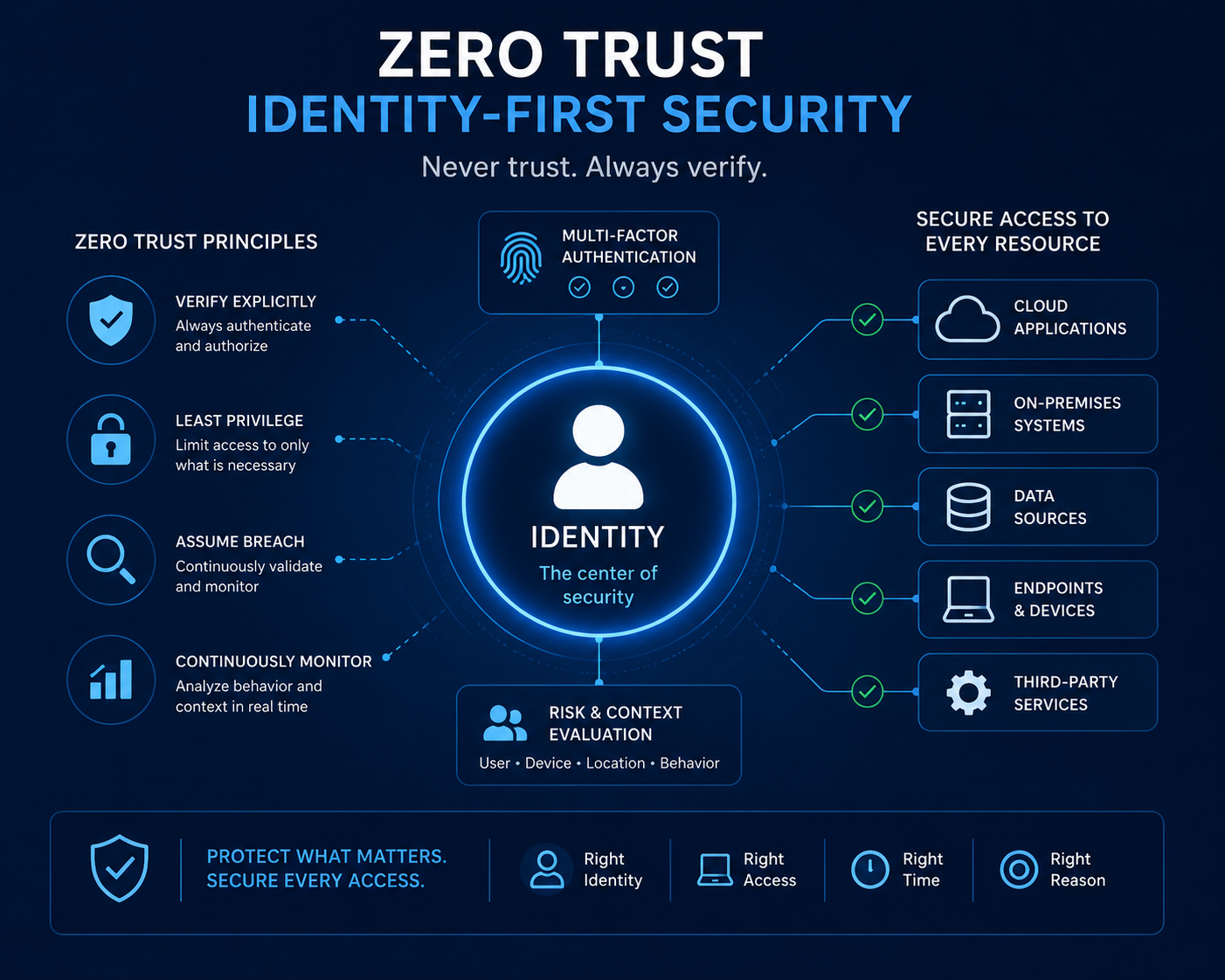
Zero Trust is a cybersecurity framework built on a simple principle: never trust, always verify.
The objective is to minimize risk by assuming that no request should be trusted by default.
Why Identity Has Become the New Firewall
As cybercriminals increasingly target credentials and user accounts, identity protection has become a critical security priority.
Today, attackers often use:
- Stolen passwords
- Credential theft
- Phishing attacks
- Session hijacking
- Social engineering techniques
Because of these threats, identity has become the first line of defense.
Zero Trust and identity-first security place identity verification at the center of access control, helping organizations reduce the risk of unauthorized access.
How Contextual Access Improves Security
One of the core principles of Zero Trust is contextual access.
Rather than relying solely on passwords or basic authentication, contextual access evaluates multiple factors before granting access.
These factors may include:
- User identity
- Device security status
- Network conditions
- Access location
- Time of access
- Previous user behavior
This approach ensures that every access request is evaluated based on current risk conditions rather than static credentials alone.
As a result, Zero Trust and identity-first security provide stronger protection against modern cyber threats.
The Role of Dynamic Risk Signals
Dynamic risk signals allow security systems to assess risk continuously and make real-time access decisions.
Examples include:
Device Health
Security systems verify whether a device is patched, updated, and compliant with security policies.
Geolocation Analysis
Sudden location changes or impossible travel scenarios may trigger additional verification.
Behavioral Anomalies
Unusual login patterns, access requests, or user activity may indicate account compromise.
Threat Intelligence Integration
Real-time threat data helps identify potentially malicious activity before access is granted.
These dynamic risk signals help organizations make smarter security decisions and reduce reliance on static authentication methods.
Benefits of Zero Trust and Identity-First Security
Organizations adopting Zero Trust and identity-first security gain several advantages.
Reduced Attack Surface
Access is limited to only the resources users need.
Stronger Protection Against Credential Attacks
Continuous verification reduces the impact of stolen credentials.
Improved Visibility
Organizations gain better insight into user activity and access patterns.
Enhanced Regulatory Compliance
Stronger access controls help meet security and data protection requirements.
Better Support for Remote Work
Users can securely access resources from anywhere without compromising security.
Together, these benefits strengthen overall cyber resilience.
Challenges of Implementing Zero Trust
While the benefits are significant, implementation can present challenges.
Common obstacles include:
- Legacy systems that lack modern security capabilities
- Complex integration requirements
- Limited visibility into existing assets
- User resistance to additional verification steps
- Resource and budget constraints
Despite these challenges, many organizations view Zero Trust as a long-term investment in cybersecurity resilience.
The Future of Access Security
As cyber threats continue to evolve, access security will increasingly depend on continuous verification and adaptive risk assessment.
Organizations are moving beyond traditional authentication methods and embracing more intelligent security models that combine identity verification, behavioral analytics, and real-time risk evaluation.
This evolution is making Zero Trust and identity-first security foundational components of modern cybersecurity strategies.
Conclusion
Zero Trust and identity-first security are redefining how organizations protect digital assets in an increasingly connected world. As traditional network boundaries disappear, identity has become the new firewall.
By verifying every access request, leveraging contextual access controls, and using dynamic risk signals, organizations can reduce cyber risk and strengthen resilience against evolving threats.
Key Takeaways
- Traditional network perimeters are becoming less effective
- Identity is now a primary cybersecurity defense layer
- Zero Trust follows a "never trust, always verify" approach
- Contextual access evaluates risk before granting access
- Dynamic risk signals improve real-time security decisions
- Zero Trust strengthens protection against credential-based attacks
FAQs
1. What is Zero Trust security?
Zero Trust is a security framework that requires continuous verification of every user, device, and access request.
2. Why is identity considered the new firewall?
Because attackers increasingly target user credentials and identities rather than network infrastructure.
3. What is contextual access?
It is an access control approach that evaluates factors such as location, device health, and user behavior before granting access.
4. What are dynamic risk signals?
They are real-time indicators such as device status, geolocation, and behavioral patterns used to assess security risk.
5. How does Zero Trust improve cybersecurity?
It reduces unauthorized access, limits attack surfaces, and strengthens protection against modern cyber threats.
Call to Action
Stay ahead of evolving cybersecurity trends and access security strategies.
Visit Elitechub.com for more cybersecurity insights, updates, and practical resources.