Introduction
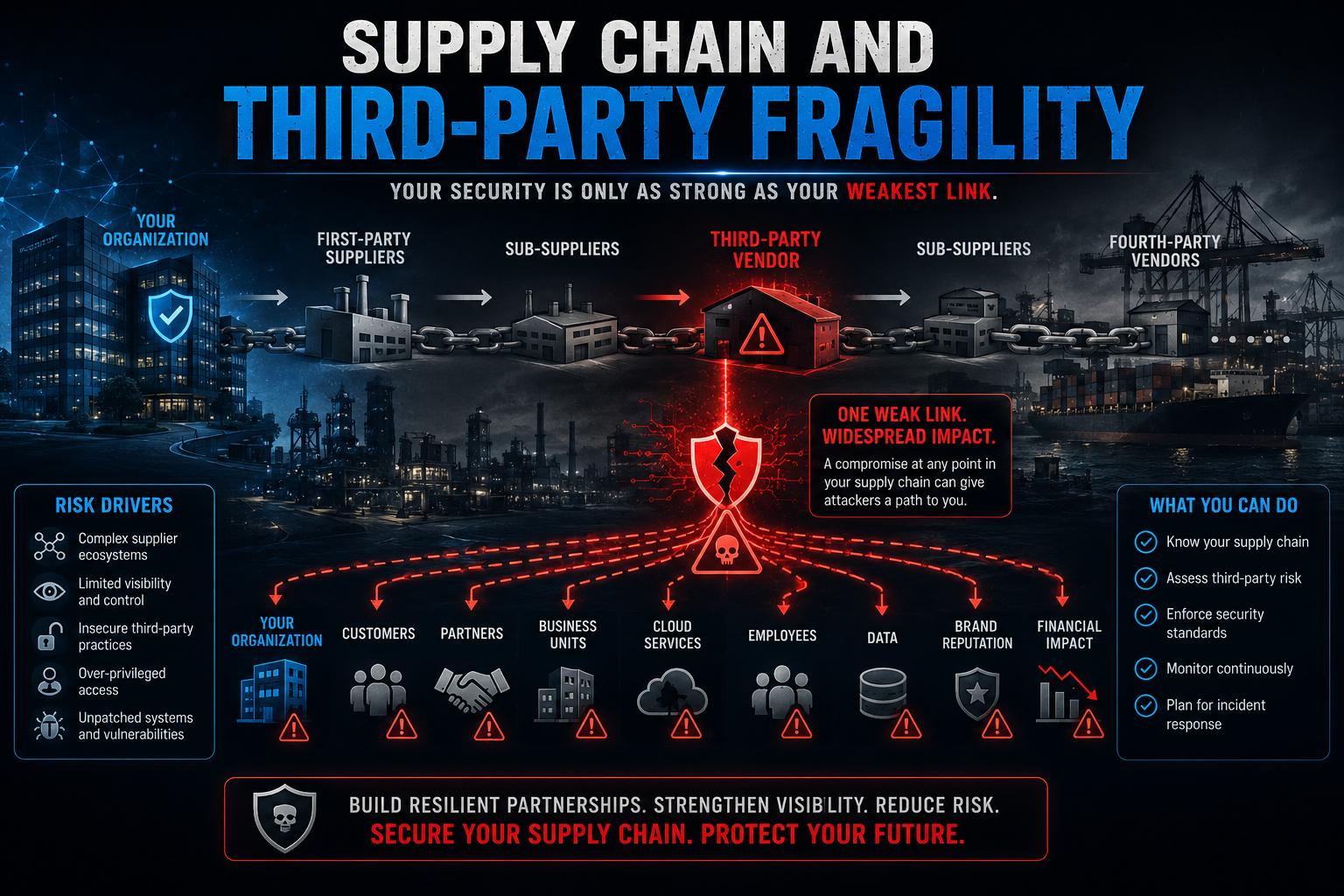
Supply chain and third-party fragility are becoming major cybersecurity concerns as organizations increasingly depend on external vendors, cloud providers, software suppliers, and managed service providers. While these partnerships improve efficiency and scalability, they also introduce new security risks that many organizations struggle to control.
Today, an organization's security is often only as strong as its weakest third-party connection. Instead of attacking highly protected targets directly, cybercriminals frequently exploit vulnerabilities within vendors and suppliers to gain access to larger networks.
As digital ecosystems become more interconnected, supply chain and third-party fragility are emerging as some of the most significant cybersecurity challenges facing businesses, governments, and critical infrastructure providers.
This post explores why supply chain attacks are increasing, the risks they create, and the strategies organizations can use to strengthen third-party security.
What Is Supply Chain Cyber Risk?
Attackers often target these external partners because they may have weaker security controls than the primary target.
Once a third party is compromised, attackers may use trusted connections to:
- Access sensitive systems
- Steal confidential data
- Deploy malware
- Disrupt operations
- Expand attacks across multiple organizations
This is why supply chain and third-party fragility continue to be a growing concern across industries.
Why Attackers Target Third Parties
Cybercriminals increasingly view third parties as attractive entry points into larger organizations.
Rather than attacking a heavily defended bank, government agency, or healthcare provider directly, attackers may compromise a vendor that already has trusted access to those environments.
This approach offers several advantages:
- Lower security barriers
- Broader access opportunities
- Ability to affect multiple victims simultaneously
- Increased chances of remaining undetected
As a result, supply chain and third-party fragility have become key factors in modern cyberattack strategies.
How Supply Chain Attacks Work
Supply chain attacks can occur in several ways.
Compromised Software Updates
Attackers inject malicious code into software updates distributed to customers.
Vendor Account Compromise
Cybercriminals steal credentials from trusted suppliers and use them to gain access to connected systems.
Third-Party Service Exploitation
Managed service providers and cloud vendors may become attack pathways into multiple organizations.
Hardware and Infrastructure Risks
Compromised devices or infrastructure components can introduce security vulnerabilities into operational environments.
These attack methods demonstrate why supply chain and third-party fragility present such significant risks.
The Impact of Supply Chain Attacks
The consequences of supply chain attacks can extend far beyond a single organization.
Common impacts include:
- Large-scale data breaches
- Operational disruptions
- Financial losses
- Reputational damage
- Regulatory consequences
- Loss of customer trust
Because one compromised vendor may serve hundreds or thousands of clients, a single incident can create widespread disruption across entire industries.
Industries Facing the Highest Risk
Although every sector relies on third-party relationships, some industries face greater exposure.
Financial Services
Banks and fintech companies depend heavily on software providers and technology partners.
Healthcare
Healthcare organizations rely on numerous third-party systems that process sensitive patient information.
Government Agencies
Public institutions often depend on external contractors and technology vendors.
Energy and Utilities
Critical infrastructure operators use specialized suppliers and service providers that can become attack vectors.
Technology Companies
Software vendors and cloud providers are frequent targets because of their extensive customer networks.
As digital dependence grows, supply chain and third-party fragility continue to affect organizations across all sectors.
Why Third-Party Risk Is Increasing
Several trends are contributing to the rise in supply chain cybersecurity risks.
First, organizations are adopting more cloud services and software integrations than ever before. Second, digital transformation initiatives continue to increase reliance on external providers.
In addition, many organizations have limited visibility into the security practices of their vendors and suppliers.
As interconnected systems expand, the attack surface grows, creating more opportunities for cybercriminals.
How Organizations Can Reduce Third-Party Risk
Managing supply chain and third-party fragility requires a proactive and continuous approach.
Conduct Vendor Security Assessments
Evaluate the cybersecurity practices of suppliers before establishing partnerships.
Implement Strong Access Controls
Limit third-party access to only the systems and data required.
Monitor Vendor Activity
Continuously monitor connections and access patterns for suspicious behavior.
Establish Security Requirements
Include cybersecurity expectations and compliance obligations in contracts.
Develop Incident Response Plans
Prepare procedures for handling third-party security incidents and disruptions.
Together, these measures help reduce risk and improve resilience across the supply chain.
The Importance of Cyber Resilience
Preventing every supply chain attack is unlikely. Therefore, organizations must also focus on resilience.
Cyber resilience involves preparing for incidents, minimizing disruption, and recovering quickly when attacks occur.
Organizations that combine strong vendor management with effective resilience strategies are better positioned to withstand evolving threats.
Conclusion
Supply chain and third-party fragility are becoming some of the most significant cybersecurity challenges in today's interconnected digital environment. As attackers increasingly target vendors, suppliers, and service providers, organizations must recognize that cybersecurity extends beyond their own networks.
By strengthening vendor oversight, improving visibility, and building cyber resilience, organizations can reduce risk and better protect their operations from supply chain-related threats.
Key Takeaways
- Supply chain attacks target vendors and trusted third parties
- Attackers often use weaker suppliers to access larger organizations
- One compromised vendor can affect multiple organizations
- Financial, healthcare, government, and energy sectors face high exposure
- Vendor assessments, monitoring, and access controls reduce risk
FAQs
1. What is a supply chain cyberattack?
It is a cyberattack that targets vendors, suppliers, or third-party providers to gain access to connected organizations.
2. Why do attackers target third parties?
Because they often have weaker security controls than the primary target.
3. Which industries are most vulnerable to supply chain attacks?
Financial services, healthcare, government, energy, and technology sectors.
4. How can organizations reduce third-party risk?
By assessing vendors, limiting access, monitoring activity, and enforcing security requirements.
5. Why is supply chain security important?
Because a single compromised supplier can create widespread operational and cybersecurity risks.
Call to Action
Stay informed about evolving cybersecurity risks and supply chain security strategies.
Visit Elitechub.com for more cybersecurity insights, updates, and practical resources.