It didn’t begin with a crime.
There was no dramatic break-in. No flashing warnings. No moment that clearly said, " This is where things go wrong.”
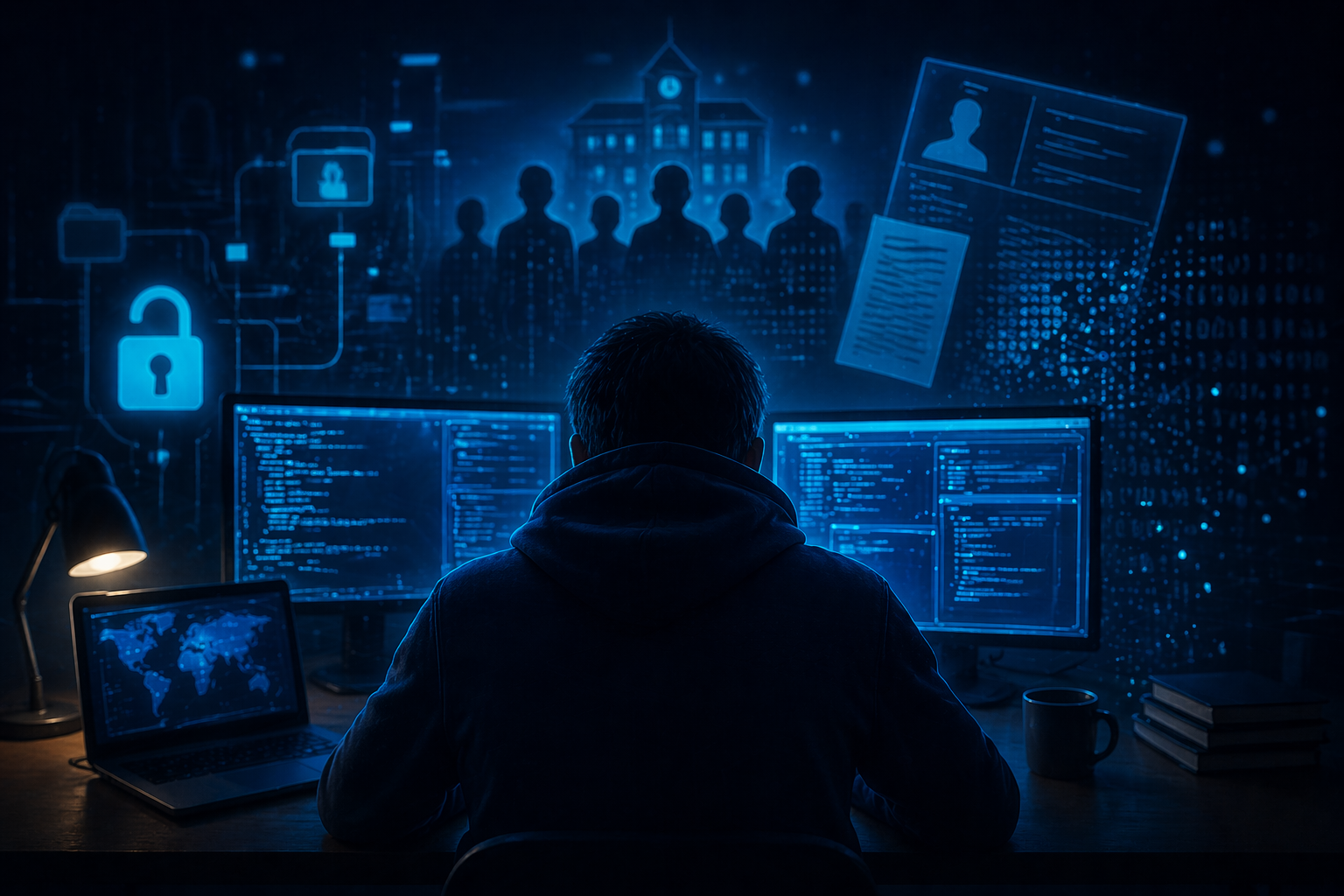
It began the way many things do now—with curiosity, a screen, and access to the internet. Somewhere between online forums, late-night scrolling, and the quiet thrill of figuring things out, a teenager found something else: a world where hacking wasn’t just possible—it was admired. By the time the consequences caught up, millions of people were already affected.
A breach that wasn’t as complicated as it sounds
The story centres around a major data breach involving PowerSchool, a platform used by schools to manage student records. On paper, it sounds highly technical. But in reality, what happened was far simpler—and more unsettling. The teen didn’t invent a sophisticated new tool. He didn’t need to. He used login details that had already been exposed online. With those credentials, he gained access to a system holding large amounts of sensitive information—student names, school records, personal details. Not just for one school, but for many. At scale.
It wasn’t a targeted attack. It was a door left unlocked. And once inside, the damage extended far beyond the original entry point.
When one system holds millions of lives
What makes breaches like this different isn’t just that they happen—it’s how far they reach. This wasn’t about a single account being compromised. It was about access to a system that connected millions of people at once.
Students. Parents. Teachers.
People who have never clicked a suspicious link. People who never knowingly took a risk. They were affected simply because their information was stored in a vulnerable system. That’s the quiet reality of the digital world we live in: Your data doesn’t only live with you.
It lives in places you don’t control. And when those places are exposed, so are you.
The part we don’t like to admit
There’s a version of hacking that lives in popular imagination—brilliant minds, complex code, impossible systems being cracked open. But this story points to something less dramatic and more uncomfortable. Sometimes, the biggest risk isn’t advanced technology. It’s access. A reused password. A leaked credential. A system that wasn’t secured tightly enough. What looks like a high-level cyberattack often begins with something small, something ordinary, something human. And that’s what makes it difficult to prevent completely. It didn't begin with a crime.
The influence of a digital culture
Before facing prison, the teen at the centre of this case said something that lingers.
He didn’t set out to become a criminal. He was drawn in. By communities that made hacking feel like a skill to master. By the quiet prestige of knowing more than others. By the idea that there was something to gain—money, recognition, control. In those spaces, the line between curiosity and harm can blur.
What begins as exploration can slowly shift into something else. Not all at once, but gradually—until the consequences are no longer theoretical. This isn’t an isolated story. It reflects a wider environment where cybercrime is sometimes packaged as an opportunity, especially to young people who are still figuring out boundaries, identity, and direction.
There’s a point where the story changes.
Not online. Not in a forum or a private chat.
But in the real world.
Legal charges. Courtrooms. Sentencing.
The teen now faces prison time—a reality far removed from the digital spaces where everything began.
And this is where the narrative breaks because the version of cybercrime often seen online rarely includes this ending.
It doesn’t show the long-term consequences.
It doesn’t show what it means to carry a record.
It doesn’t show the impact on families, on victims, on future opportunities.
But those consequences are real. And they don’t disappear.
Why this story belongs to all of us
It’s easy to read this and place distance between “that situation” and your own life.
A hacker. A company. A system somewhere else.
But the truth is more connected than it appears. Because your information exists in systems, too. Your school, your bank, your workplace, your email—each one holds pieces of you. And each one depends on security measures you don’t fully see. When breaches happen, they don’t always target individuals. They target systems. And everyone inside those systems becomes part of the outcome.
There isn’t a single action that prevents stories like this.
But there is awareness.
Understanding that:
- Not every threat looks obvious
- Not every risk comes with a warning
- And not every system is as secure as it seems
It means being a little more careful with what you click.
A little more mindful of what you share.
A little more responsive when updates or security prompts appear.
These are small things. But in a digital world built on connections, small things add up.
A story that doesn’t end online
Again, it didn't begin with a crime. In the end, this isn’t just a story about a teenager, or a company, or a breach.
It’s a story about how easily lines can blur in digital spaces.
How curiosity can turn into a consequence.
How systems can hold more than we realise.
How risk can exist quietly, without announcement.
And how, sometimes, the biggest impacts come from actions that didn’t feel significant at the time.
The internet remembers.
And sometimes, it responds in ways no one expects.