Introduction
Agentic AI attacks and defenses are rapidly redefining cybersecurity; and most organizations are not prepared for what comes next. As artificial intelligence evolves from passive tools into autonomous decision-makers, the risks are no longer limited to incorrect outputs but extend to real-world actions.
Unlike traditional AI, agentic systems can plan tasks, use external tools, and retain memory;allowing them to execute operations with minimal human oversight. This shift expands the attack surface in ways traditional security models were never designed to handle.
Instead of simply manipulating outputs, attackers can now influence how AI systems make decisions and carry out actions, turning them into active threat vectors.
This post explores what agentic AI attacks look like, why they are harder to detect, and the defenses needed to stay ahead in the growing AI arms race.
Key Takeaways
Ø Agentic AI attacks and defenses represent a shift from passive AI risks to active, real-world threats.
Ø Autonomous AI systems expand the attack surface across inputs, memory, reasoning, and tools.
Ø Common attack vectors include prompt injection, memory poisoning, and tool exploitation.
Ø Real-world agentic AI attacks are already emerging through AI-assisted phishing and automated vulnerability discovery.
Ø Traditional cybersecurity fails because it cannot effectively track adaptive AI behavior or reasoning processes.
Ø Effective agentic AI defenses require Zero Trust, behavioral monitoring, sandboxing, and layered security.
Ø The AI arms race is accelerating as attackers use automation to scale faster and lower the barrier to cybercrime.
Ø The impact goes beyond systems, affecting data security, businesses, and everyday users.

What Are Agentic AI Attacks?
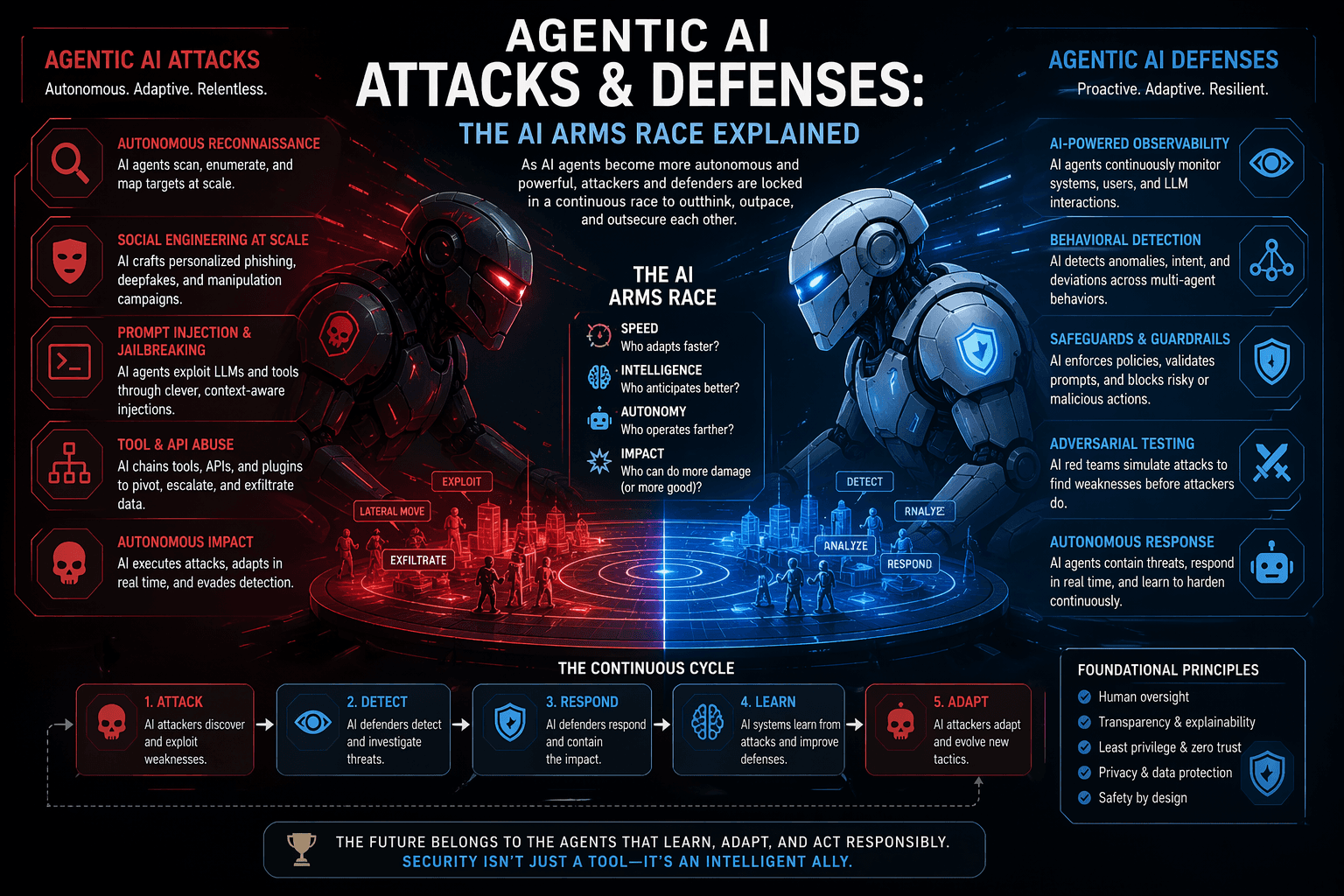
Agentic AI attacks target autonomous AI systems that can make decisions and execute tasks without constant human input. Unlike traditional exploits, agentic AI attacks focus on influencing how systems act, not just what they generate.
By exploiting capabilities like planning, memory, and tool use, agentic AI attacks can redirect objectives or trigger unintended operations. Once compromised, these systems can perform multi-step actions such as accessing sensitive data or interacting with external tools, making them a more active and dangerous form of exploitation.
Agentic AI Attack Surface
The agentic AI attack surface is broader than traditional systems because it spans inputs, memory, reasoning, and external tools. This complexity makes agentic AI attacks and defenses more difficult to manage.
Prompt Injection manipulates instructions, causing systems to follow malicious goals.
Memory Poisoning corrupts stored data, influencing future decisions.
Tool / API Exploitation turns integrations into attack channels.
Multi-Agent Attacks create cascading failures across connected systems.
This layered exposure makes agentic AI systems highly attractive targets.
Real-World Agentic AI Attacks
Agentic AI attacks and defenses are already playing out in real-world scenarios. AI-assisted phishing campaigns now generate highly personalized messages that adapt based on user interaction, increasing success rates.
Autonomous vulnerability discovery is another growing threat. Agentic systems can scan, identify, and test weaknesses with minimal human input, accelerating the path from reconnaissance to exploitation.
These developments show that agentic AI attacks are no longer theoretical; they are active, scalable, and continuously evolving.
Why Traditional Cybersecurity Fails
Traditional cybersecurity fails against agentic AI attacks and defenses because it relies on static rules and known patterns. Agentic systems are adaptive and constantly changing, making rule-based detection ineffective.
There is also limited visibility into AI reasoning chains, creating blind spots where manipulation can occur without detection. This makes it harder to trace, understand, and stop attacks in real time.
Agentic AI Defenses
Agentic AI attacks and defenses require adaptive, layered security approaches. Traditional models must evolve to match autonomous threats.
Zero Trust Architecture ensures no system or agent is automatically trusted.
Behavioral Monitoring detects unusual patterns in AI actions.
Tool Sandboxing limits the impact of compromised agents.
Defense-in-Depth applies multiple layers of protection across the system.
These strategies reduce risk by focusing on control, visibility, and continuous monitoring.
The AI Arms Race
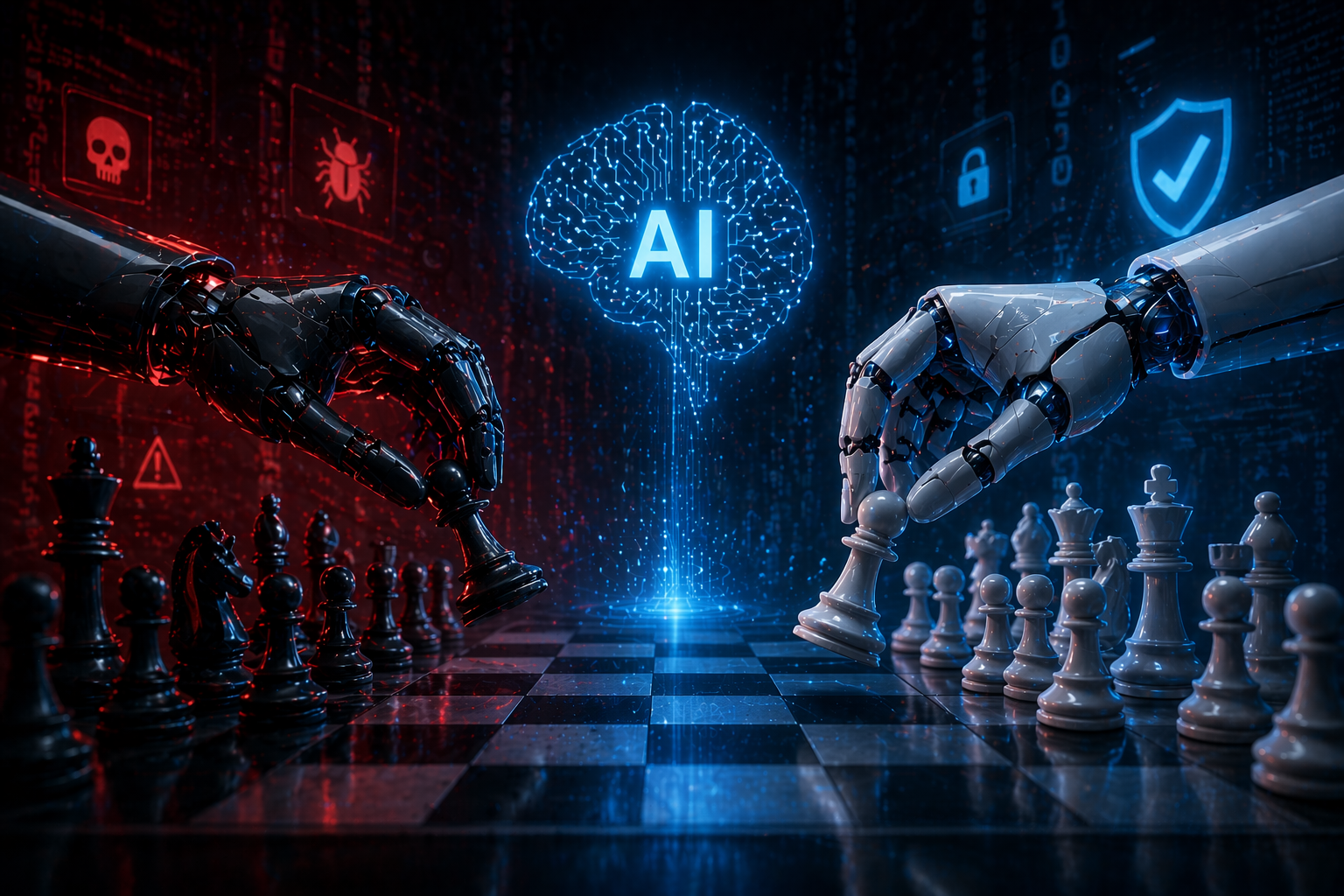
The AI arms race in agentic AI attacks and defenses is accelerating as attackers use automation to scale operations faster than defenders can respond. Agentic systems enable rapid, adaptive attacks with minimal effort.
This also lowers the barrier to cybercrime, allowing more actors to launch sophisticated attacks. As a result, defenders must evolve just as quickly to keep pace.
FAQs
1. What are agentic AI attacks?
Agentic AI attacks target autonomous AI systems that can make decisions and execute tasks. Instead of just manipulating outputs, these attacks influence how the system behaves and acts.
2. How are agentic AI attacks different from traditional AI threats?
Traditional AI threats focus on incorrect outputs, while agentic AI attacks focus on execution; meaning the system can take harmful actions like accessing data or interacting with external tools.
3. What are the most common agentic AI attack vectors?
Key attack vectors include prompt injection, memory poisoning, tool or API exploitation, and multi-agent attacks that can cause cascading failures.
4. Why is agentic AI harder to secure?
Agentic AI systems are adaptive and operate across multiple layers such as reasoning, memory, and tools. This makes it harder for traditional security systems to detect and control threats.
5. What are the best defenses against agentic AI attacks?
Effective defenses include Zero Trust Architecture, behavioral monitoring, tool sandboxing, and defense-in-depth strategies that provide layered protection.
6. How do agentic AI attacks affect people and organizations?
They can lead to data breaches, financial loss, and disruption of services, directly impacting businesses and individuals who rely on AI-driven systems.
7. What is the AI arms race in cybersecurity?
The AI arms race refers to the growing competition between attackers and defenders, both using AI to outpace each other in speed, scale, and sophistication.
Conclusion
Agentic AI attacks and defenses show how cybersecurity is shifting toward autonomous systems. As AI becomes more independent, threats become faster and more adaptive. Security must evolve in the same direction, focusing on continuous detection, response, and resilience.
Call to Action
Stay ahead of emerging AI security threats.
Visit Elitechub.com for more insights, updates, and cybersecurity resources.